Entry deadline: 28 February 2027
Judging period: March 2027
Shortlist announcement: April/May 2027
Awards Ceremony & Gala Dinner: 30 June 2027
Principles for entrants
- Provide evidence to support every claim you make. Evidence should be, where possible, robust and independent.
- Do not submit the same, untailored entry to every category.
- Do not submit marketing or promotional materials.
All entrants must include
- A summary of the submission (one paragraph) – 300 word max.
- A high resolution photo or logo.
- Geographical location (town, country).
- An explanation of the contribution made, or that could be made, to the AD industry, and why it was outstanding.
- Robust and verifiable evidence to document the claims being made.
- Evidence of measurable impact. Every entry must include quantified evidence of the impact of the nominee, project or plant. Each category sets out what this should show.
Entry format
- Each written response is limited to 300 words, across all categories and questions.
- Multiple entries are welcome, but every entry should be specific to the entered category.
The ADBA/WBA team checks the winners and shortlist for any issues with entries.
The Women in Biogas award recognises the achievements of women in a sector where they are substantially underrepresented. It rewards the achievements of women working within the biogas industry, with the aim of raising the profile of biogas as an attractive career path and inspiring others to enter the industry as well as encouraging excellence.
Entry Criteria
This award will be judged by reference to the following information:
- A CV/detailed description of the nominated woman, or group of women in biogas.
- A 300-word summary giving details of the role performed.
- A 300-word summary of how the nominee has made a difference to the performance of the business. This could be a change in culture or operational practice that has increased efficiency, or simply being brilliant and innovative in an aspect of biogas that has taken the business to another level. What impact have they made, and over what timescale?
- Measurable impact (mandatory): quantified evidence of the difference made, with a baseline and timescale. Examples: improvements in efficiency, performance or retention; growth in the number of women recruited, mentored or promoted; reach and outcomes of a programme or initiative.
Who Should Enter?
Any woman involved in any aspect of biogas development, from design through to process and operation.
We want to know about any individual, organisation or company making an outstanding contribution to the development of anaerobic digestion in the UK or global biogas industry.
Entry Criteria
This award will be judged by reference to the following information:
- A 300-word summary of how the nominated individual has contributed to the development of anaerobic digestion and biogas in the UK or internationally. The contribution must have been made within the last 2 years.
- Measurable impact (mandatory): the value of the contribution must be quantified and evidenced. Examples: capacity developed, waste diverted, emissions avoided, investment secured, jobs or skills created, innovative initiative, policy or regulatory outcomes.
Who Should Enter?
Any individual making an outstanding contribution to the development of AD and biogas in the UK or global industry. Entrants can nominate someone else, or themselves.
We want to hear about any company, organisation or team that provides outstanding support in the AD and biogas industry (UK and globally). Entries should ideally come from those who have been the recipients of the outstanding support, rather than those providing it, or be accompanied by testimonials from the recipients.
Entry Criteria
This award will be judged by reference to the following information:
- A 300-word summary of what support was provided, and why it was outstanding.
- Any relevant data or information to support the claim.
- Any difficulties or challenges that the support provider addressed and helped to overcome
- Two testimonials outlining why the entrant should win this award
- Measurable impact (mandatory): quantified outcomes of the support for those who received it, supported by recipient data. Examples: downtime reduced, costs saved, output or yield increased, compliance or accreditation achieved.
Who Should Enter?
Companies and organisations only (Including individual consultants). This includes AD designers; builders; developers; operators; technology and equipment suppliers; food and drink businesses; waste management companies; technical, legal and accounting consultants; and academic institutions.
The Education Campaign of the Year award recognises exceptional efforts in raising awareness and understanding of anaerobic digestion (AD) and biogas. It celebrates campaigns, outreach programmes, and public engagement initiatives that have made a measurable impact in promoting the benefits and potential of AD, whether nationally or internationally.
Entry Criteria
This award will be judged by reference to the following information:
- A 300-word summary outlining how the campaign advanced the education and awareness of AD and biogas within a specific region, nation, or globally.
- The origin of the initiative and the outcomes achieved.
- A link or reference to the campaign materials or activity for review (for example a website, a folder of material, or a video). More items can be uploaded on the next page.
- Measurable impact (mandatory): specific metrics showing the impact of the campaign. Examples: audience reach, participants or attendees, engagement figures, survey results showing a change in awareness or attitudes against a baseline, and any resulting behaviour or policy change.
Who Should Enter?
Any individual, organisation or company that has actively launched an educational or outreach campaign, public engagement initiative, or communication programme related to AD or biogas.
The Net Zero Circular Award recognises people, companies or teams in the value chain who can demonstrate how they have closed the loop, turning waste into a product. According to the IEA, AD sits at the heart of the circular economy, and to deliver global net zero targets we need carbon negative technologies, which AD coupled with CCU technology can deliver.
Entry Criteria
Entrants must address both Section A and Section B. Each response is limited to 300 words.
Section A: closed loop
- How the AD operation delivers a closed loop system, minimising the use of virgin materials
- Evidence of feedstock supply and off-takers for products (biomethane/electricity, bio-CO2 and biofertiliser). Examples include domestic food waste delivering a local heat network, biomethane as transport fuel, a food manufacturer using all four outputs, and manures and slurries powering cheese production. Evidence on maximising resource efficiency is welcome.
Section B: net zero delivery
- Evidence of steps taken and controls to prevent fugitive emissions; use of all outputs from the AD facility (biogas, bio-fertiliser, bio-CO2); and innovative steps to reduce indirect impacts, for example pumping digestate to lagoons to avoid transportation.
- Innovative steps taken to mitigate or offset GHG emissions, such as private wires, local heat networks, biomethane-fueled logistics, and use of CO2.
- Measurable impact (mandatory): quantified evidence of the results delivered. Examples: GHG emissions avoided or reduced (tCO2e), fugitive emissions monitoring data, proportion of outputs used, virgin materials displaced.
Who Should Enter?
Local authorities with separate food waste collections delivering electricity/biogas for heat and/or public transport; food manufacturers deploying biogas to reduce the carbon footprint of their products; fleet managers deploying RNG-fuelled trucks; AD operators who have enabled the above; an AD facility that has deployed CCU; CO2 supply chain off-takers; and food manufacturers deploying AD to decarbonise logistics fleet and heat, and capturing CO2 to carbonate products.
The Biogas Plant of the Year award recognises exemplary performance and innovation in biogas plant design, operation and impact on a global stage. It celebrates plants that demonstrate technical excellence, sustainability and a strong contribution to the circular economy. Plants that inject biomethane into the gas grid should enter the Biomethane Plant of the Year category (category 8).
Entry Criteria
This award will be judged by reference to the following information:
- A 300-word summary: an explanation of the feedstock, process, outputs and main technologies used.
- An outline business case, and the objectives and criteria for success.
- How the plant makes the most of its feedstock, biogas and digestate and, if appropriate, the benefits delivered to the business, with supporting data/information. Details of any specific challenges overcome in the development of the plant.
- Details of any certification, lifecycle assessments and sustainability assessments undertaken.
- How the feedstock use is advancing the local landscape.
- Circular economy contribution (digestate, feedstock, CO2 and so on).
- Quantified financial information: figures that support the business case. Examples: revenue, operating costs, cost savings, payback period or return on investment.
- Measurable impact (mandatory): performance and environmental figures from operation of the plant. Examples: uptime/availability, biogas yield, energy generated, GHG emissions avoided, tonnes of waste processed, digestate quality.
Who Should Enter?
International and UK plants can enter.
The Micro & Small-Scale On-Farm AD of the Year award celebrates excellence and innovation in small-scale anaerobic digestion systems, recognising projects that demonstrate the practical, sustainable and efficient use of biogas technologies at farm or community level. The category highlights on-site waste processing operations that do not import external waste or crops for energy production, and plants designed primarily for local energy use, whether for internal business operations or to meet community energy demand.
Entry Criteria
This award will be judged by reference to the following information:
- A summary of the project, how it has led to the development of Micro-AD or Small-Scale plants, and the impact of the initiative.
- Details of any specific challenges overcome in the development of the project.
- Any further supporting data/information.
- An explanation of the feedstock, process, outputs and main technologies used, an outline business case, and the objectives and criteria for success.
- Clear statements of differentiation, which may include how the plant makes the most of its feedstock, biogas and digestate, and the benefits delivered to the business, with supporting data.
- Details of the feedstock, the efficiency of the digester, and how the project efficiently uses the products of the digester, with supporting data.
- Quantified financial information: figures that support the business case. Examples: energy costs offset, revenue, cost savings, payback period.
- Measurable impact (mandatory): output data that proves the output of the plant, stated as thermal output (and any electrical output), with the proportion used on site or in the community.
Each written response is limited to 300 words.
Who Should Enter?
Any AD plant below the thermal output limit, from anywhere in the world. The limit is defined by thermal output (the 2026 limit was 0.2 MW; value to be confirmed for 2027). This includes farmers (including combines and joint ventures), individuals, companies or initiatives that operate a Micro/Small AD or Small Scale on Farm AD (SOFAD) plant; developers who also operate their plants; community groups; digestate treatment companies; equipment suppliers; land managers; operators; seed manufacturers; consultants; hospitality; and others.
This award recognises exemplary performance and innovation in plants that upgrade biogas to biomethane and inject it into the gas grid. It celebrates technical excellence in production and grid injection, sustainability and a strong contribution to the circular economy and the decarbonisation of gas.
Entry Criteria
This award will be judged by reference to the following information:
The plant must inject biomethane into the gas grid and should have been operating from 2025 onwards. Judged by reference to:
- A 300-word summary: an explanation of the feedstock, process, biogas upgrading technology, grid injection arrangements and outputs.
- An outline business case, and the objectives and criteria for success.
- How the plant makes the most of its feedstock, biogas, biomethane and digestate, and, if appropriate, the benefits delivered to the business, with supporting data/information. Details of any specific challenges overcome in the development of the plant, including grid connection.
- Details of any certification, lifecycle assessments and sustainability assessments undertaken.
- How the feedstock use is advancing the local landscape.
- Circular economy contribution (digestate, feedstock, bio-CO2 and so on).
- Quantified financial information: figures that support the business case. Examples: revenue, operating costs, cost savings, payback period or return on investment.
- Measurable impact (mandatory): biomethane production and environmental figures from operation of the plant. Examples: volume of biomethane injected (for example GWh or m3 per year), injection availability, methane slip or loss, GHG emissions avoided, tonnes of waste processed, bio-CO2 captured or used.
Who Should Enter?
Operators of biomethane-to-grid plants, international and UK.
Now split into two sub-categories by Technology Readiness Level (TRL), using the nine-level scale used by the European Commission.
This award recognises an individual, organisation, company or educational body in the industry that has made an outstanding contribution to the development of anaerobic digestion and biogas in the UK or globally through innovation or research.
Sub-categories and TRL scale
Entrants choose a sub-category according to the TRL of the research or innovation at the closing date. An innovation may be entered in one sub-category only.
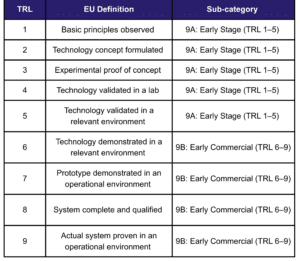
9A: AD Research and Innovation Award – Early Stage (TRL 1–5)
For research and innovation from basic principles through to validation in a relevant environment.
Entry criteria
This award will be judged by reference to the following information:
- A 300-word summary of how the nominee has contributed, or has the potential to contribute, to the development of biogas and anaerobic digestion in the UK or internationally, quantifying, if possible, the value of that contribution.
- A statement of the TRL claimed (1–5), with evidence such as experimental results, validation data, publications or patents.
- Any relevant data or information to support this.
- Any difficulties or challenges that the research and innovation provider addressed and helped to overcome.
- Two testimonials outlining why the entrant should win this award.
- Any relevant data or information to support this;
- Any difficulties or challenges that the research and innovation provider addressed and helped to overcome
- Two testimonials outlining why the entrant should win this award
- Measurable impact (mandatory): results from experiments, trials, pilots or validation work, with the method and baseline stated. Examples: improvement in biogas or methane yield, process stability, emissions reduction, or cost reduction; independent verification where possible.
9B: AD Research and Innovation Award – Early Commercial (TRL 6–9)
For research and innovation demonstrated in a relevant or operational environment, through to proven commercial systems.
Entry criteria
This award will be judged by reference to the following information:
- A 300-word summary of how the nominee has contributed to the development of biogas and anaerobic digestion in the UK or internationally, quantifying, if possible, the value of that contribution.
- A statement of the TRL claimed (6–9), with evidence of demonstration or deployment, such as the plants or sites where it has been tested or installed, and commercial traction.
- Any relevant data or information to support this.
- Any difficulties or challenges that the research and innovation provider addressed and helped to overcome.
- Two testimonials outlining why the entrant should win this award.
- Measurable impact (mandatory): performance data from relevant or operational environments. Examples: measured improvements in plant performance, efficiency or emissions, cost savings for users, number of installations or customers; independent verification where possible.
Who Should Enter?
Any individual, company, organisation or education body making an outstanding contribution to the development of anaerobic digestion and biogas in the UK or globally through innovation or research. Entrants can nominate an individual in their own business or in another organisation.
The AD Solution Provider of the Year award recognises organisations or companies that have delivered exceptional solutions to advance the anaerobic digestion industry. It celebrates those who have identified and effectively addressed key challenges in the design, development, construction or operation of AD facilities, demonstrating innovation, collaboration and measurable impact.
Entry Criteria
This award will be judged by reference to the following information:
- A 300-word summary of the issue and how the solution has contributed to overcoming that problem within biogas and anaerobic digestion in the UK or internationally, quantifying, if possible, the value of that contribution.
- A 300-word summary of the innovation and effectiveness of the solution and its impact on AD plant performance, efficiency or sustainability.
- A 300-word summary about collaboration and execution, including multi-stakeholder involvement.
- A 300-word summary about the overall contribution to advancing the AD sector and the wider impact of overcoming the issue.
- Any relevant data or information to support this.
- Two testimonials outlining why the entrant should win this award.
- Measurable impact (mandatory): before-and-after or comparative data showing the effect of the solution. Examples: improvement in plant performance, efficiency or availability, cost or emissions reduction, number of installations or plants affected.
Who Should Enter?
Developers; technology providers; and consultants who took part in more than one aspect, for example design, providing technology, helping with financing or permitting, general development of the plant, building or operating the plant.